
It plans to increase India sales by a tenth, helped largely by launches next year

Tokyo has mostly delivered on that hope, despite some early teething problems.

Modi is courting Japanese investment in an ambitious industrial "corridor" to run between Delhi and Mumbai.

The China auto show saw some amazing models being rolled out, some for the first time. Rajesh Karera/Rediff.com picks the best of the lot.

Market leaders saw good traction for new cars, including the electric ones.
Primary steel producers in the domestic market have raised product prices by 2.5 to 3 per cent for December to address margin compression and in anticipation of a demand pick-up.

Implementation of the Seventh Pay Commission recommendations, One Rank, One Pension are the other triggers going ahead, analysts say

Many say Tata Motors has perhaps paid the price for being too ambitious.
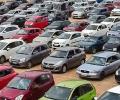
Passenger vehicle exports from India increased 43 per cent in FY22, with Maruti Suzuki India leading the segment with dispatches of over 2.3 lakh units, as per the latest data by industry body SIAM. The total passenger vehicle (PV) exports stood at 5,77,875 units in 2021-22 fiscal, as compared to 4,04,397 units in 2020-21. Passenger car shipments saw 42 per cent growth at 3,74,986 units, while utility vehicle exports rose 46 per cent at 2,01,036 units during the last fiscal, the data by the Society of Indian Automobile Manufacturers (SIAM) showed.

Maruti Suzuki India and Tata Motors reported decline in sales during June this year.

That means a manufacturer looking at a market like India needs to decide whether small, cheap cars or small, expensive cars or both will work better for them, says Pavan Lall.

Market leader Maruti Suzuki is putting finishing touches to its plan of finding its feet in what is being hailed as a battle of epic proportions in India's fastest-growing passenger vehicle segment, reports Arindam Majumder.

While hybrids, CNG and biofuels found favour in 2018 among many carmakers including Maruti Suzuki, Mercedes-Benz, Toyota and Honda, others such as M&M and Tata Motors have shown full faith in electric vehicles.

Various factors, including robust demand in rural markets and good response to new models, helped in driving the sales.
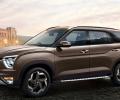
Close to half a dozen more three-row premium mid-size models are expected to hit the road over the next two years.

Buying a car, particularly a diesel-powered one, is set to pinch the customers' pockets even more from the next financial year, as the second phase of Bharat Stage VI (BSVI) emission norms kicks in. The rules require cars to be compliant with real driving emission (RDE) norms, which measure pollutants emitted by cars while they are being driven on the road, unlike in a laboratory test. The norms may increase the cost of producing diesel vehicles by nearly Rs 75,000 to Rs 80,000, and petrol-powered ones by Rs 25,000 to Rs 30,000, analysts said.

A clutch of automakers including Maruti Suzuki, Hero MotoCorp, Mercedes Benz India, Eicher Motors, TVS Motor, and Isuzu Motors India announced they had got the clearance from the governments of the states they operate in to resume operations.
Aria has a 14 per cent share in the UV segment, clocking in sales of 225-250 units a month.
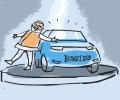
From Hyundai to Tata Motors, automakers are staring at a bleak future. With no succor provided in the Budget, the pain for companies is likely to continue for the next two quarters.

The Carens is a warning for cars such as the Tata Safari, Hyundai Alcazar, Maruti Ertiga, Toyota Innova Crista and Mahindra XUV 700, because Kia punches much harder than others in its weight category.

Reflecting the woes of the Indian automobile industry, the country's car exports remained flat at 550,466 units in 2013-14, during which domestic sales fell for the second consecutive year.
Automobile manufacturers are offering freebies, ranging from gold coins and LED televisions to record discounts, to push petrol vehicle sales.

Toyota Kirloskar Motor on Wednesday signed leading Bollywood actor Aamir Khan as brand ambassador to promote its utility vehicle Innova in India.

Earlier in May, Ford India announced that it had dropped its plans to make electric vehicles (EVs) in India, which it intended to export, under the production-linked incentive scheme (PLI). Ford was among 20 companies that had signed a Champion OEM Incentive Scheme under the PLI project with the government in February this year. The decision comes as a blow for the 4,000-odd employees at Ford India's Maraimalai Nagar plant near Chennai and in Sanand, Gujarat. In September last year, the company had announced that it would exit the India market, which it had entered in 1995 through an on-again, off-again joint venture with Mahindra & Mahindra (they split in 1998, signed a JV in 2019 and split again in December 2020), retailing petrol and diesel brands such as the EcoSport, Figo, Aspire, and Endeavour.

Cumulative sale at India's top six passenger vehicle (PV) makers dropped 0.7 per cent to 267,000 units, from 269,000 a year before.
Led by the country's largest car maker Maruti Suzuki, Ford India, General Motors and Toyota Kirloskar logged overall growth in sales volumes.

Even as domestic passenger car sales declined 29.4 per cent between April and August this year, exports grew 6.5 per cent, partially cushioning the blow from slowing sales.
Manufacturers that mainly sell diesel cars like Mahindra & Mahindra, Tata Motors, Toyota, Mercedes, BMW and Volkswagen anticipate a significant fall in sales if the government accepts the Parikh committee's recommendation of a flat tax of Rs 80,000 on diesel cars, because of a widening cost differential with petrol variants.

Manufacturers that mainly sell diesel cars like Mahindra & Mahindra, Tata Motors, Toyota, Mercedes, BMW and Volkswagen anticipate a significant fall in sales if the government accepts the Parikh committee's recommendation of a flat tax of Rs 80,000 on diesel cars, because of a widening cost differential with petrol variants.
In a rare face off, captains of the auto industry have hit out at the government for not walking the talk. At an industry event in the capital on Wednesday, R C Bhargava, chairman of India's largest carmaker Maruti Suzuki, and Venu Srinivasan, chairman of TVS Motor, questioned the government's intent to support the auto sector. Revenue secretary Tarun Bajaj sat in the audience listening, before his turn came to counter them.

Maruti has announced it will phase out diesel variants from April 1, 2020, when stringent BS VI norms take effect
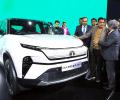
'I'm very much against petrol and diesel....'' 'I travel in an electric car.' 'I have had a really good experience with it.'
Automakers finish 2008 on a bleak note. Expect 2009 to be worse.

A weaker rupee against the US dollar and the Japanese yen along with margin sustenance pressures have forced companies to raise prices.

The ban does not speak about used luxury cars.

Seven auto companies lost share in the current year because of different reasons.
Even as some automakers limp, others charge ahead.

What worked for Hyundai in India when so many other auto manufacturers have had to eat humble pie? Pavan Lall finds out.

Big brands like Hyundai, Mahindra and Mahindra (M&M), Toyota and Renault have lost share.
 © 2026 Rediff.com - Advertise with us - Disclaimer - Privacy Policy - Sitemap - Feedback - About us - Terms of use - Grievances